Kontinuum
Kontinuum is a framework for building your own private (or public) cloud on hardware you control. One Kubernetes-style API discovers bare-metal machines, claims them into pools, and bootstraps Kubernetes clusters on top of them — and is growing to cover networking, virtualization, and managed databases as well. See Vision & roadmap for the full picture of where kontinuum is headed and what's available today.
Under the hood, kontinuum is a real Kubernetes-style API server, built on kommodity's libkapi package, so you get kubectl, CRDs, and everything else that comes with speaking the Kubernetes API, backed by whatever storage you point it at (SQLite, PostgreSQL, etcd, ...).
Where to go next
- Vision & roadmap — why kontinuum exists, the long-term "metacloud" idea of a single pane of glass across European and international infrastructure providers, and what's available today vs. planned across bare-metal, networking, compute, and databases.
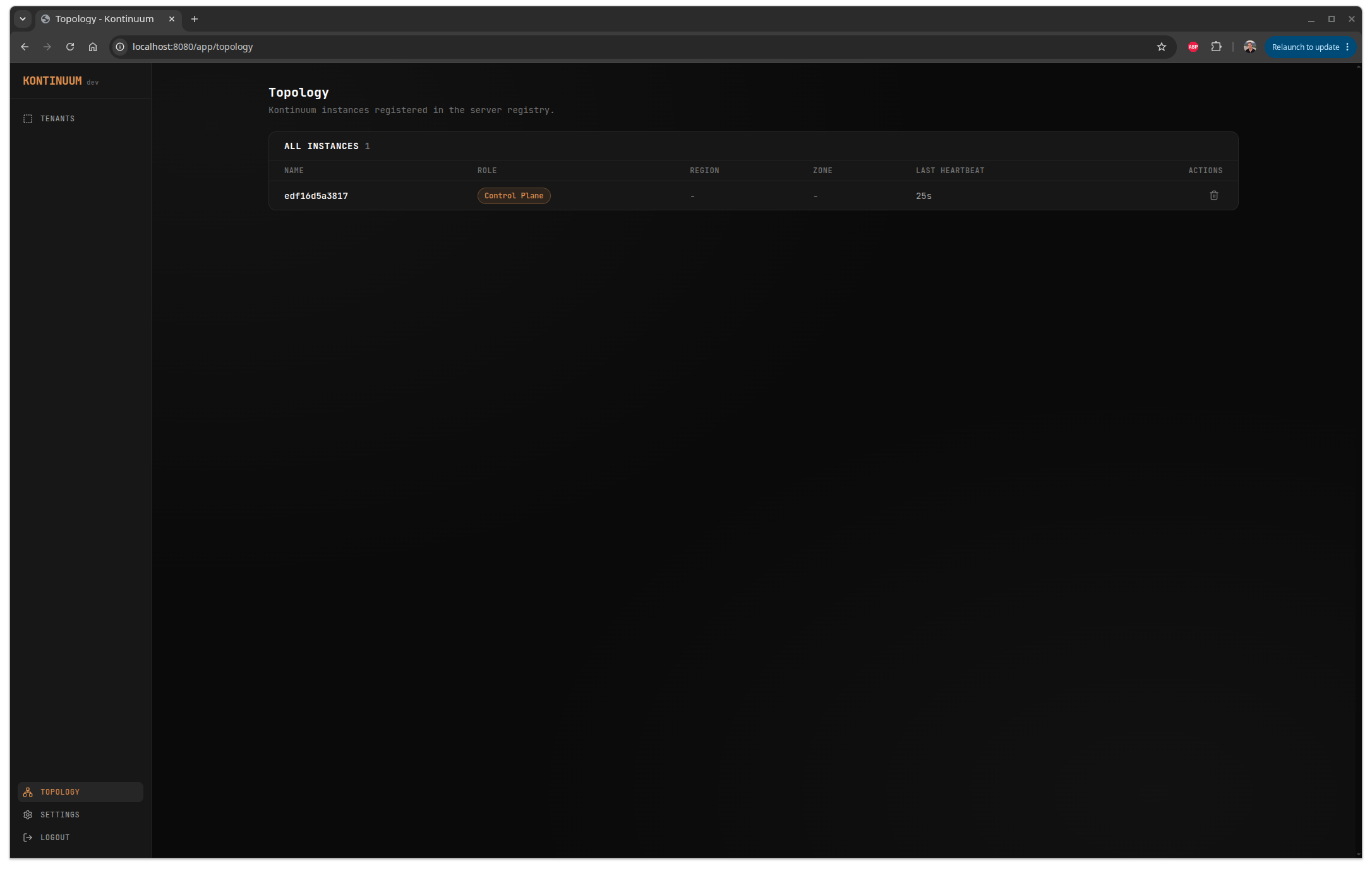
- Architecture — how the server, controllers, and UI fit together.
- Running via Docker — the fastest way to try kontinuum, no Go toolchain required.
- Production deployment — putting TLS and authentication in front of kontinuum before you expose it.
- Authentication — the OIDC/PKCE login flow, anonymous access, and how to turn each on.
- Add zone — how kontinuum turns bare-metal machines into a running Talos Kubernetes cluster and installs itself onto it.
- Remove zone — tearing a zone's downstream footprint back down and resetting its seed node.
- Contribution guidelines — conventions for contributing to kontinuum.
- Local setup — build kontinuum from source and run the hot-reload dev environment.
- API reference — the CRDs and configuration variables that make up kontinuum's API, and the generated field reference.
What kontinuum does today
Kontinuum manages Instance, InstancePool, and TalosCluster custom resources through a Kubernetes-style API of its own — the same kubectl-compatible interface you'd use against a real cluster — to discover machines, claim them into pools, and bootstrap Talos Kubernetes clusters on top of them, with Cilium and cert-manager installed as addons. See Architecture for how the pieces fit together, or Vision & roadmap for what's next.